This interface gives access to actions that can be executed for accessible objects. More...
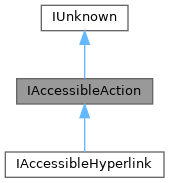
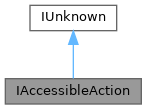
Public Member Functions | |
| HRESULT | nActions ([out, retval] long *nActions) |
| Returns the number of accessible actions available in this object. | |
| HRESULT | doAction ([in] long actionIndex) |
| Performs the specified Action on the object. | |
 Public Member Functions inherited from IUnknown Public Member Functions inherited from IUnknown | |
| HRESULT | QueryInterface ([in] REFIID riid, [out, iid_is(riid)] void **ppvObject) |
| ULONG | AddRef () |
| ULONG | Release () |
Properties | |
| BSTR | description ([in] long actionIndex) [get] |
| Returns a description of the specified action of the object. | |
| long | keyBinding ([in] long actionIndex,[in] long nMaxBindings,[out, size_is(, nMaxBindings), length_is(, *nBindings)] BSTR keyBindings) [get] |
| Returns an array of BSTRs describing one or more key bindings, if there are any, associated with the specified action. | |
| BSTR | name ([in] long actionIndex) [get] |
| Returns the non-localized name of specified action. | |
| BSTR | localizedName ([in] long actionIndex) [get] |
| Returns the localized name of specified action. | |
Additional Inherited Members | |
| Public Types inherited from IUnknown | |
| typedef IUnknown * | LPUNKNOWN |
Detailed Description
This interface gives access to actions that can be executed for accessible objects.
Every accessible object that can be manipulated via the native GUI beyond the methods available either in the MSAA IAccessible interface or in the set of IAccessible2 interfaces (other than this IAccessibleAction interface) should support the IAccessibleAction interface in order to provide Assistive Technology access to all the actions that can be performed by the object. Each action can be performed or queried for a name, description or associated key bindings. Actions are needed more for ATs that assist the mobility impaired, such as on-screen keyboards and voice command software. By providing actions directly, the AT can present them to the user without the user having to perform the extra steps to navigate a context menu.
The first action should be equivalent to the MSAA default action. If there is only one action, IAccessibleAction should also be implemented.
Definition at line 578 of file iaccessible2.idl.
Member Function Documentation
◆ doAction()
Performs the specified Action on the object.
- Parameters
-
[in] actionIndex 0 based index specifying the action to perform. If it lies outside the valid range no action is performed.
- Return values
-
S_OK S_FALSE if action could not be performed E_INVALIDARG if bad [in] passed
- Note
- If implementing support for media, refer to the predefined constants in the IA2Actions enum.
◆ nActions()
Returns the number of accessible actions available in this object.
If there are more than one, the first one is considered the "default" action of the object.
- Parameters
-
[out] nActions The returned value of the number of actions is zero if there are no actions.
- Return values
-
S_OK
- Note
- This method is missing a [propget] prefix in the IDL. The result is the method is named nActions in generated C++ code instead of get_nActions.
Property Documentation
◆ description
Returns a description of the specified action of the object.
- Parameters
-
[in] actionIndex 0 based index specifying which action's description to return. If it lies outside the valid range an empty string is returned. [out] description The returned value is a localized string of the specified action.
- Return values
-
S_OK S_FALSE if there is nothing to return, [out] value is NULL E_INVALIDARG if bad [in] passed
◆ keyBinding
|
get |
Returns an array of BSTRs describing one or more key bindings, if there are any, associated with the specified action.
The returned strings are the localized human readable key sequences to be used to activate each action, e.g. "Ctrl+Shift+D". Since these key sequences are to be used when the object has focus, they are like mnemonics (access keys), and not like shortcut (accelerator) keys.
There is no need to implement this method for single action controls since that would be redundant with the standard MSAA programming practice of getting the mnemonic from get_accKeyboardShortcut.
An AT such as an On Screen Keyboard might not expose these bindings but provide alternative means of activation.
Note: the client allocates and passes in an array of pointers. The server allocates the BSTRs and passes back one or more pointers to these BSTRs into the array of pointers allocated by the client. The client is responsible for deallocating the BSTRs.
- Parameters
-
[in] actionIndex 0 based index specifying which action's key bindings should be returned. [in] nMaxBindings This parameter is ignored. Refer to Special Consideration when using Arrays for more details. [out] keyBindings An array of BSTRs, allocated by the server, one for each key binding. The client must free it with CoTaskMemFree. [out] nBindings The number of key bindings returned; the size of the returned array.
- Return values
-
S_OK S_FALSE if there are no key bindings, [out] values are NULL and 0 respectively E_INVALIDARG if bad [in] passed
◆ localizedName
Returns the localized name of specified action.
- Parameters
-
[in] actionIndex 0 based index specifying which action's localized name should be returned. [out] localizedName
- Return values
-
S_OK S_FALSE if there is nothing to return, [out] value is NULL E_INVALIDARG if bad [in] passed
◆ name
Returns the non-localized name of specified action.
- Parameters
-
[in] actionIndex 0 based index specifying which action's non-localized name should be returned. [out] name
- Return values
-
S_OK S_FALSE if there is nothing to return, [out] value is NULL E_INVALIDARG if bad [in] passed
The documentation for this interface was generated from the following file:
- sdk/include/wine/iaccessible2.idl